Tadgh Gibson's
Creative
Portfolio

Fiddlers In the Pine
(2025)
Fiddlers in The Pine is a dark cartographic puzzle box set in colonial Appalachia, mixing tabletop and Twine. Players are divided between the roles of The Draftsman and The Trappers, the former acting as gamemaster and The Trappers working with/against each other to escape the map realm.


Touch the puzzle cube to view the illustrated rule book


The project was awarded a distinction as part of Lancaster University's MA Modular Creative Course:
Fiddlers, as a critical piece of writing, attempts to inspire deceit, competition, argument and discomfort. Offering a player-coloniser critique, was perhaps the aspect of the game that received the strongest feedback in workshopping. This was a great success towards my iterative process, since I worried that Munchenheim! offered a rather toothless rendering of body-snatching. Fiddlers, by contrast, hopes to inspire a crab bucket mentality reflective of the competitive state of North American fur trading at the time.
What I learned:
Whilst observing play-testers, I found the game's greatest successes laid in its unique interrogation towards maps-as-tools and the rulebook's quality as a game device, with ephemera, personality, and notation to paw over. Rather than something that is accepted to be trudged through and then put to the side after initial explanation, the rules here require for a rolling teach. One that subverts expectation and allows for a continual, collaborative storytelling experience.
Munchenheim!
(2024)
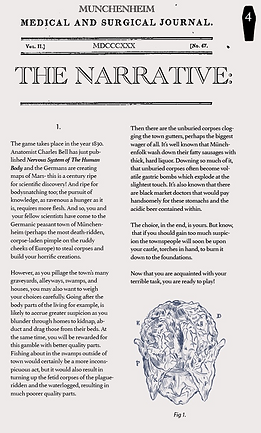
Munchenheim! Is a multiplayer tabletop gothic horror board-game inspired by the work of Mary Shelley and the history of resurrectionist practices in the 19th century. Players assume the roles of Frankenstein-esque scientists competing to assemble and reanimate their own corpses. In essence, Bloodborne meets Mr. Potato Head.
.png)


Touch the eye to view the hand-illustrated rule book.


The project was awarded an A* as part of Lancaster University's Writing For Games course:
"The narrative design is intricate, but works harmoniously in practice to give players a gory gothic experience worthy of the game’s themes. From choosing victims and digging up bodies, to discovering era-appropriate boons or setbacks, to skulking around town or hiding at home, to presenting your mosaic body to a “scientific” audience, all of this is appropriately grimy. The mechanics absolutely reflect the narrative, in novel and fun ways. The very act of having to look up one’s victim is especially darkly thrilling, and the meter for being discovered is sufficiently generous that players can relish in being blatant. What fun!"- Dr. Oliver K. Langmead
What I learned:
Through the playtesting and development of Munchenheim! I learned to appreciate the involving, diegetic quality of board game tactility and how to curate an appropriately gothic room feel . Physical participation in all aspects of the game world, with heavy coins as gamepieces and a focus on the sensation of touch and spatial presence, became key design goals towards immersing players in their roles.

